
Onboarding Events: Welcome New Hires at Your Retreat


Onboarding events have evolved. The era of handing a new hire a laptop, a stack of policy documents, and a calendar invite to a 90-minute HR orientation is fading — and for good reason. For companies serious about retention, culture, and performance, onboarding is increasingly being woven into something more intentional: the team offsite.
Including new employees in your corporate retreat creates a rare opportunity to compress months of relationship-building into a few high-quality days. But it also introduces real planning complexity. How do you make new hires feel genuinely welcomed rather than overwhelmed? How do you balance orientation needs against the rest of the team's goals? And how do you avoid the awkward "everyone already knows each other" dynamic that makes offsites hard for newcomers?
This guide is for HR executives, executive assistants, and offsite planners who want to get this right — practically, not just in theory.
Key Takeaways
• Onboarding events integrated into team offsites accelerate new hire ramp time and deepen cultural belonging faster than traditional orientation formats.
• Timing matters: the first 30–90 days is the high-leverage window for offsite-based onboarding.
• Effective offsite onboarding balances structured integration (introductions, context-setting) with unstructured social time — both are essential.
• New employees should be visible participants, not passive observers. Program design should reflect this.
• Pre-retreat preparation and post-retreat follow-through are as important as what happens on-site.
Why the Offsite Has Become a Strategic Onboarding Venue

The logic is straightforward: the corporate retreat is one of the few moments when your entire team is present, focused, and away from the noise of day-to-day work. That makes it unusually well-suited to the core challenge of onboarding — helping a new person understand not just what the company does, but how people work together, what the culture actually feels like, and who they can rely on.
Research consistently shows that new hires who build strong internal relationships early perform better and stay longer. Gallup's long-running engagement research has found that employees who have a best friend at work are seven times more likely to be engaged in their jobs — a consistent finding across decades of workforce data. Yet remote and hybrid work has made organic relationship-building slower and less likely. The offsite, in this context, isn’t a luxury — it’s one of the highest-leverage investments you can make in a new employee’s trajectory.
There’s also a cultural signal embedded in the gesture itself. Inviting a new hire to a team retreat early in their tenure communicates something important: you’re already one of us. That signal is harder to manufacture through onboarding software or video calls.
When to Include New Hires in a Team Offsite
Not every timing scenario is equal. In practice, the sweet spot for onboarding events at offsites tends to fall within the first 30–90 days of employment — early enough to shape foundational impressions, late enough that new hires have enough context to participate meaningfully — early enough that the retreat shapes their foundational understanding of the company, but late enough that they’ve had a few weeks to get their bearings.
Bringing someone in during their first week can be overwhelming if the retreat is heavily context-dependent (strategy reviews, deep-dive product discussions) and they don’t yet have the frame of reference to engage meaningfully. Waiting too long, on the other hand, means they’ve already formed impressions and habits without the benefit of the team’s in-person culture.
A few scenarios worth distinguishing:
• Rolling new hire inclusion: If your team holds quarterly offsites, consider whether every new hire who joins within a given quarter is automatically included in the next one. This creates a consistent, scalable process rather than case-by-case decisions.
• Cohort onboarding events: For companies that hire in larger groups, a dedicated offsite onboarding event for a cohort — separate from or adjacent to the broader team retreat — can create a peer cohort with shared context and relationships.
• Annual all-hands timing: If your company's primary offsite is an annual all-hands, new hires hired more than three months prior should generally be treated as full participants, not new attendees.
How to Design Onboarding Events Within a Team Offsite

The most common mistake planners make is treating new employee onboarding as a separate track running parallel to the main retreat — a "new hire orientation session" at 8 a.m. while everyone else sleeps in. This approach signals, unintentionally, that new hires are on a different tier.
The better model integrates onboarding into the retreat structure while also providing new hires with what they actually need: context, relationships, and a sense of belonging. Here’s how that plays out across the program:
Pre-Retreat Preparation for New Employees
Before the retreat, new hires should receive a brief orientation packet — not a document dump, but a curated set of context: who’s attending, what the team’s current priorities are, any company shorthand or terminology that might come up, and a map of the relationships they’re walking into. A 20-minute call with their manager or a buddy before the retreat can do more to reduce first-day anxiety than any amount of pre-reading.
Structured Introductions Built Into the Program
The worst version of this is the round-robin “name, role, and fun fact” opener that forces 40 people to sit through 40 introductions. The better version is a designed activity — small group discussions, structured one-on-ones, team history timelines — that surfaces relationships and context organically while giving new hires visible moments to contribute.
Consider building an opening session that explicitly acknowledges who is joining the team for the first time. Not as a performance, but as a genuine welcome. Something as simple as: “We have four people joining us for their first team offsite. We want to make sure you leave here feeling like you’ve landed in the right place.”
Assigning a Retreat Buddy
Pair each new hire with a tenured team member — not their direct manager — whose informal job is to make sure they’re not standing alone at lunch, know which sessions to prioritize, and have someone they can ask candid questions. This is a low-effort, high-impact structural choice.
Balancing Integration with Full Participation
New hires should participate in the same sessions as everyone else wherever possible. Separating them into orientation tracks during sessions where their perspective would actually be valuable is a missed opportunity — and subtly signals they’re not yet “real” participants. Reserve any new-hire-specific content for the edges of the agenda: early morning, a brief optional session, or as pre-reading rather than programmed time.
Team Building Activities That Work for Mixed-Tenure Groups
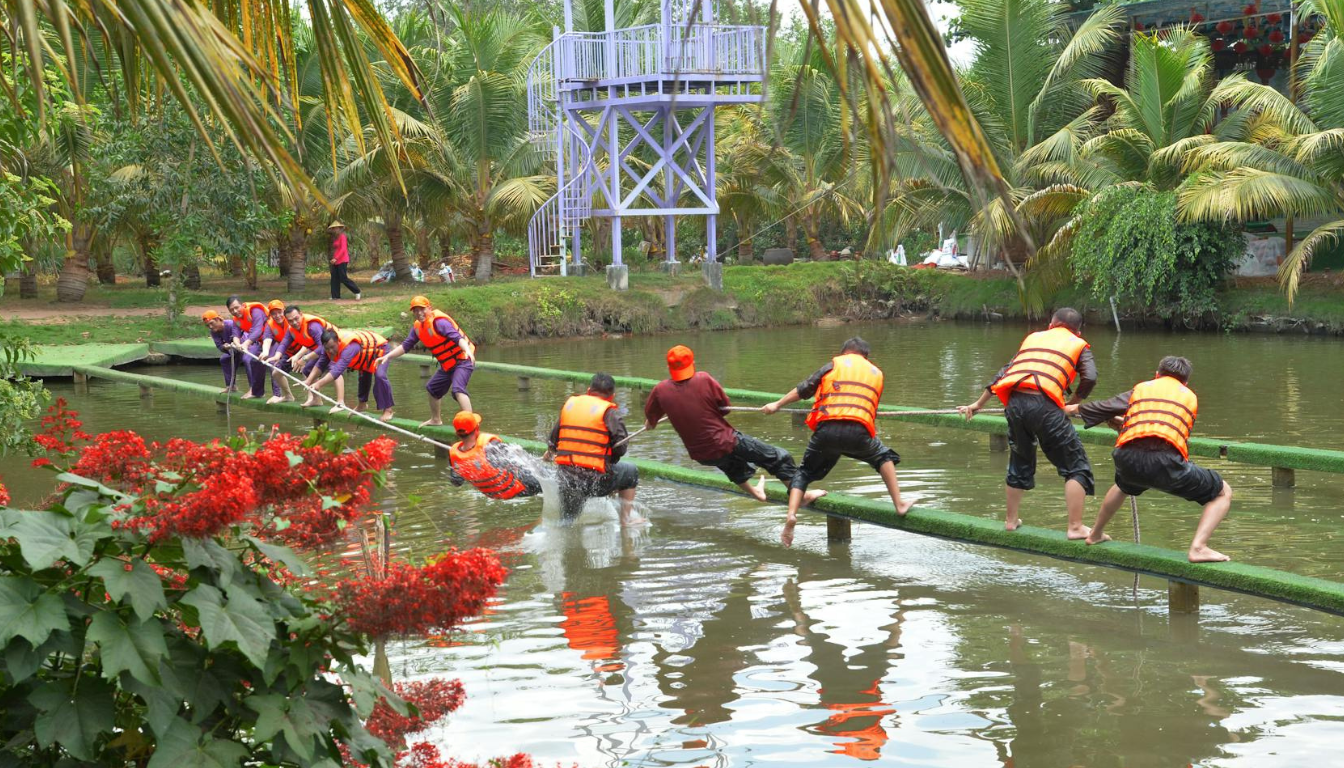
The classic tension in planning team offsite activities for a mixed group — veterans who’ve done three retreats together and newcomers who don’t yet know people’s last names — is that the activities that deepen existing relationships can inadvertently exclude people who don’t yet share those references.
The activities that work best for welcoming new employees at retreats tend to share a few characteristics: they create genuine interaction rather than surface-level co-participation, they don’t require existing context to engage, and they produce shared memories that become reference points going forward.
High-impact options include:
• Collaborative problem-solving: Structured challenges — whether a creative build exercise, a business simulation, or a community service project — level the playing field. New hires often bring a fresh perspective that makes them genuinely valuable contributors.
• Storytelling and history sessions: A facilitated session where team members share the history of the company, key decisions, or formative moments gives new hires context while engaging veterans in reflection. It’s onboarding that doesn’t feel like onboarding.
• Outdoor and experiential activities: Hiking, kayaking, cooking classes, or similar experiences don’t require shared history to be enjoyable. They generate new shared experiences that become the foundation of future inside jokes and references.
• Small-group dinners with intentional seating: Unstructured time is where real relationships form, but intentional seating — mixing new hires with people they haven’t yet met — prevents the default clustering that leaves newcomers on the outside.
What to Avoid When Welcoming New Employees at a Retreat
A few patterns reliably undermine the goal of genuine integration:
• Making new hires perform: Extended introductions, “tell us your whole career history,” or spotlight moments before they have a relational footing can create anxiety rather than connection.
• Overloading the schedule: New hires are already in a state of high cognitive load. A relentless agenda with no downtime is hard for veterans; for newcomers, it’s exhausting.
• Assuming they’re caught up: Internal jargon, acronyms, references to past projects or events — these create invisible barriers. Facilitators and session leaders should be briefed to define terms and provide context.
• Ignoring the post-retreat window: The week after the retreat is when relationships either solidify or fade. A brief structured follow-up — a check-in call, a shared channel where retreat memories and action items live, a nudge for people to schedule one-on-ones with people they connected with — extends the investment significantly.
How Offsite Supports Onboarding-Inclusive Retreat Planning
Planning a retreat that works for both tenured team members and new hires requires thoughtful venue selection, program design, and logistics coordination. Offsite makes it easier to source venues suited to mixed-experience groups — properties with flexible spaces for both structured sessions and informal connection, with the kind of environment that puts people at ease rather than on performance.
Beyond venue sourcing, Offsite’s platform supports itinerary building that accounts for varied participant needs, helping planners design programs that integrate new employee onboarding naturally rather than as an afterthought. For HR teams managing increasingly distributed workforces, that kind of planning support is more than a convenience — it’s a meaningful part of getting the outcome right.
Summary
Onboarding events don’t have to be separate from your broader team culture-building strategy — in fact, the most effective approach is to integrate them. The team offsite is one of the highest-leverage venues for welcoming new employees because it compresses relationship-building, cultural immersion, and strategic context into a short, high-quality window. When designed thoughtfully, it gives new hires a foundation that would otherwise take months to build.
The key is intentionality at every stage: pre-retreat preparation that reduces anxiety, program design that makes new hires visible contributors rather than passive observers, activities that work across tenure levels, and post-retreat follow-through that extends the investment. Done well, onboarding at the offsite doesn’t just benefit new employees — it strengthens the whole team’s sense of shared identity and purpose.
FAQs
- What are onboarding events, and how do they differ from standard orientation?

Onboarding events are structured experiences designed to integrate new employees into a company’s culture, relationships, and working norms. Unlike standard orientation — which tends to be process-focused (benefits enrollment, policy review, system access) — onboarding events prioritize human connection and cultural belonging. When incorporated into a team offsite, they leverage in-person time to accelerate relationship-building in ways that remote or in-office orientation formats typically can’t match.
- When is the right time to invite a new hire to a team retreat?
The 30–90 day window tends to be the sweet spot. The sweet spot is early enough that the retreat shapes the new hire's foundational understanding of the team and culture, but late enough that they have enough context to engage meaningfully in sessions. For teams with quarterly offsites, many HR leaders build in a standing policy of including anyone hired in the preceding quarter.
- How do you make new employees feel included at a team retreat without singling them out?
The key is structural integration rather than spotlight moments. Assign a retreat buddy from the tenured team. Design activities that don't require shared history or existing team context to participate meaningfully. Brief facilitators to define internal jargon. Build in enough unstructured time for organic conversation to happen. Acknowledge new hires warmly at the start, but let the program itself — rather than extended introductions — do the work of building connection.
- What types of team-building activities work best when onboarding new employees at a retreat?
Activities that create genuine interaction and don’t require shared history tend to work best: collaborative challenges, outdoor or experiential activities, storytelling and company history sessions, and small-group meals with intentional seating. The goal is to generate new shared experiences that become part of the team’s common reference points, which new hires are now a part of from the start.
You may also like



Stay Updated with Our Insights
Get exclusive content and valuable updates directly to you.